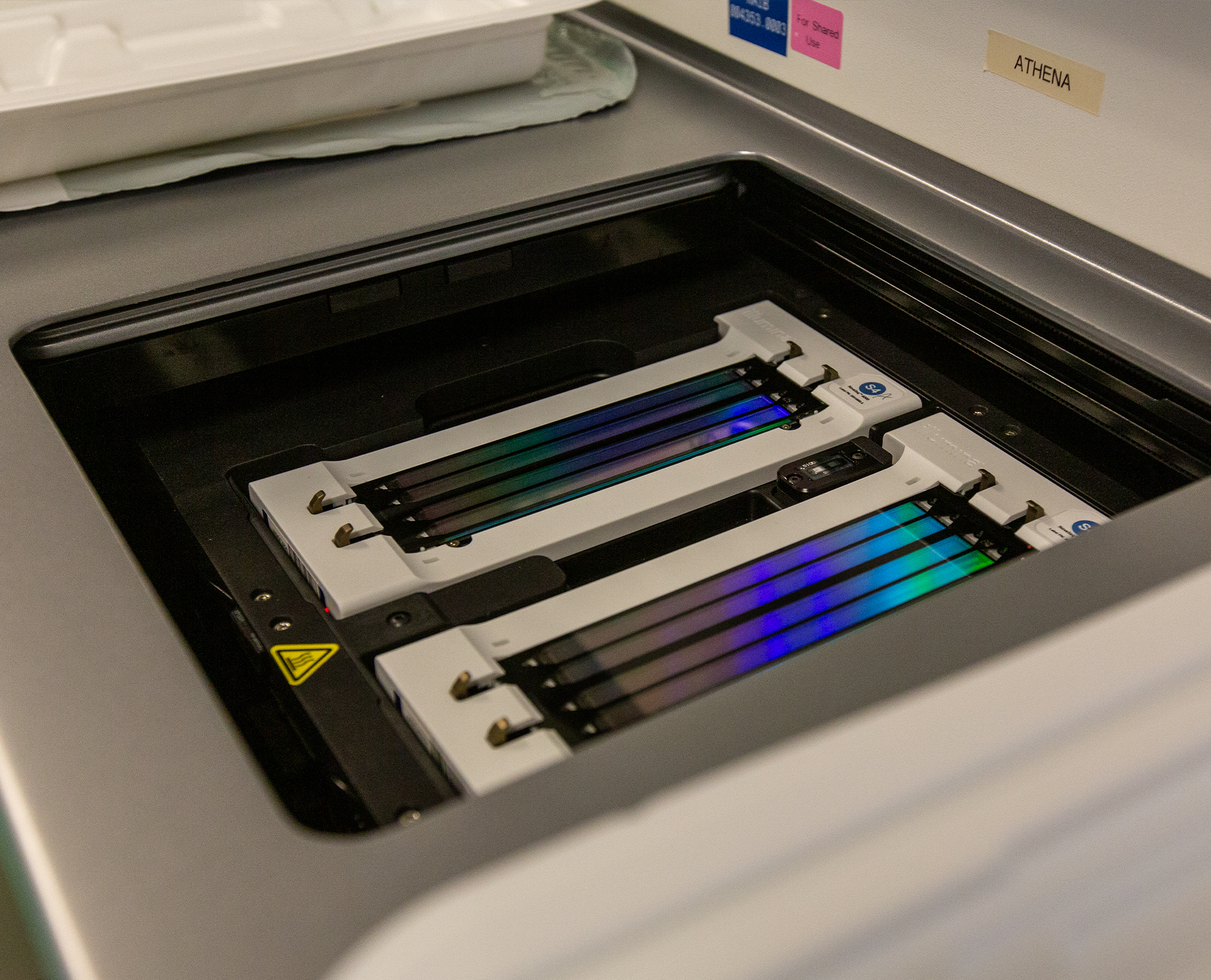
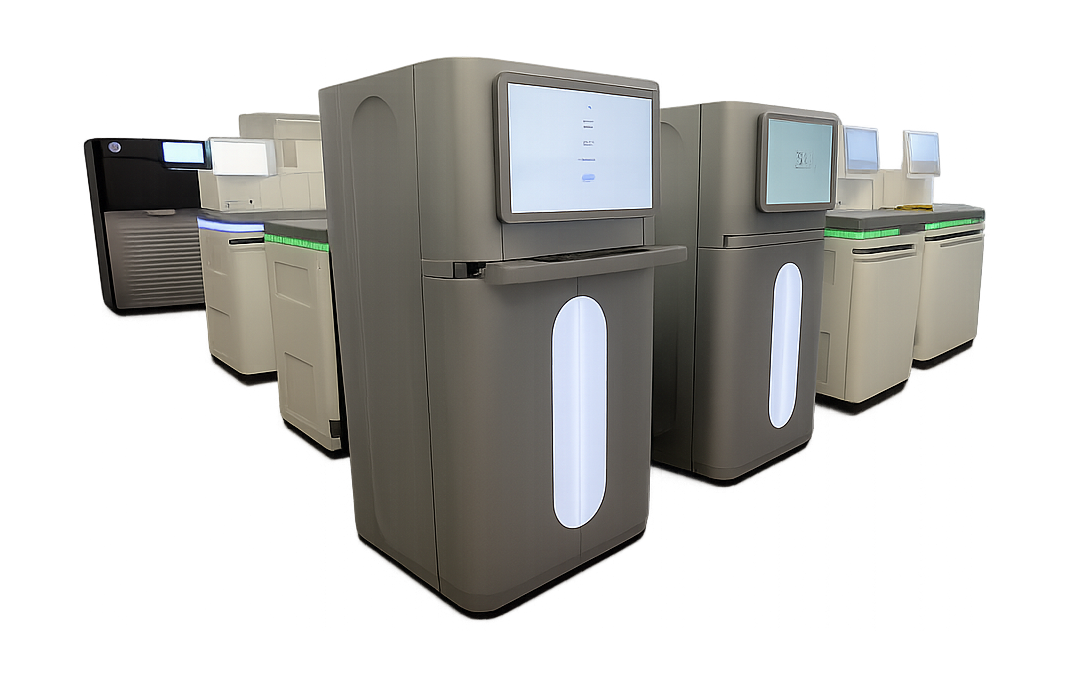
Scalable, customizable, and powered by bioanalytics excellence.
We have the technology, automation, and expertise to quickly reach your study goals – whether you’re embarking on a large-scale clinical whole genome sequencing study or have a one-time need to support basic research.
From extraction to publication-ready insights, we deliver a fully integrated WGS workflow designed for precision, speed, and scientific excellence.
Quality That Starts at the Bench
Achieve consistent, high-yield DNA extraction from even the most challenging clinical or research materials. Our validated workflows ensure exceptional performance across whole blood, FFPE, PBMCs, fresh-frozen tissues, and cultured cells.
Engineered for Whole Genome Sequencing
Our analytically validated library preparation workflows ensure optimal coverage and uniformity, even from low-input or partially degraded samples.
Speed Without Compromise
Deliver ultra-fast turnaround without sacrificing coverage depth or accuracy.
Cross-validated on Illumina NovaSeq 6000 & NovaSeq X Plus
Flexible coverage options (30×, 60×, and beyond) for both germline and somatic applications
Clinical-grade reliability proven across diverse sample types and genome complexities
Insights Delivered Instantly
Through our partnership with DNAnexus, your sequencing data becomes actionable faster than ever.
Discovery Genomics has spent years optimizing our proprietary workflows, developing robust processes that include a method for dual extraction of RNA and DNA from FFPE tissues that delivers higher quality and quantities of RNA without negatively impacting DNA quality and quantity.
Whole genome sequencing determines nearly all DNA bases across the genome, detecting SNVs, small indels, CNVs and structural variants in coding and non-coding regions. Whole Exome Sequencing (WES) focuses on ~1–2% of the genome (primarily protein-coding regions) and is a cost-effective way for variant discovery in known genes, especially for Mendelian disorders. WES are limited to a predefined gene set and therefore they may miss large rearrangements or deep intronic mutations. WES is better suited for specific clinical questions (e.g., oncology gene panels, pharmacogenomics, or hereditary cancer testing) when speed, cost, or established interpretation pipelines are priorities.
Choose WGS over WES when you need unbiased variant discovery, combined SNV/CNV/SV calling, or future-proof data for re-analysis.
30x coverage (germline standard) balances between cost and accuracy for SNVs and small indels in research cohorts.
60x+ coverage improves sensitivity for mosaicism, heterogeneous tissue, FFPE, or challenging regions.
100x coverage (tumor/rare variant studies) has higher confidence in low-allele-fraction variants and difficult genomic contexts.
Discovery offers configurable depths with paired-end 2×150 bp reads and matched bioinformatics tiers to fit study design.
You can select tiered deliverables from raw FASTQ through aligned BAM/CRAM, gVCF/VCF (SNVs/indels), and optional CNV/SV calling, cohort joint-calling, and interpretation-ready reports. Secure cloud or hard-drive delivery and archival storage are available. Our bioinformatics tiers match coverage and sample type, and include QC reports at each step.
Discovery accepts blood, saliva, cells, tissue (incl. FFPE where appropriate) and extracted DNA. We provide validated extraction and library prep, QC at intake and post-library, and automated workflows to reduce failures. For challenging samples (FFPE/low input), we adjust library strategies and recommend higher coverage to protect sensitivity.
Data is transferred via encrypted channels with access-controlled cloud delivery or physical media on request. Cohort projects can be organized in workspace-based cloud buckets to streamline collaboration and re-analysis. We maintain auditable QC and processing logs and provide long-term storage options aligned to sponsor requirements.
Yes. Discovery integrates WGS with RNA-seq, methylation, proteomics (e.g., Olink®), and clinical/phenotypic data through unified bioinformatics to support mechanism-of-action studies, patient stratification, and biomarker discovery. Our end-to-end support spans sample sourcing, wet lab, and analytics, reducing vendor hand-offs.
Contact us at info@dls.com or click here and we will put you in touch with the right experts to discuss your project.
A Scope of Work (SOW) and/or Purchase Order (PO) must be completed before arranging any sample shipment. Shipments received prior to receipt of proper information will be quarantined and may be returned to the sender if needed information and official documentation is not received in a timely manner. It is suggested that a project kick-off discussion be conducted prior to shipment of any samples to ensure alignment with the laboratory activities upon receipt of samples.
An Analytical Plan will be compiled by your dedicated project manager. The Analytical Plan details laboratory activities and ensures client alignment prior to any sample processing.
The Analytical Plan will be shared with you for edits and comments. Discovery’s quality standards require that the Analytical Plan is agreed upon and signed off by Discovery and the client prior to any testing being performed.
Your primary contact throughout your project will be your dedicated project manager.
NOTE: Some projects may not require a formal Analytical Plan if deemed out of scope for the nature of the project at Discovery's discretion. This will be discussed with your Project Manager during the initiation of each project.
All sample shipments will require a clearly defined manifest including protocol/study identification, sample information, patient ID (if available), and contact information for shipper(s) to rectify missing and/or ambiguous information.
Click here to see sample shipment requirements.
Any shipments missing this critical information will be put into quarantine and may experience extended turnaround times