The work our customers do depends on materials and data they can trust. Increasingly, it also depends on a supply chain that takes responsibility for its environmental footprint. We take sustainability seriously, both as a scientific partner and as a company operating global laboratories, freezer farms, and providing specimen and service solutions that engage global logistical networks.
We have set emissions reduction targets aligned to the 1.5°C pathway as outlined in the Paris Agreement, to be reached by 2031. These targets cover our footprint across each of the Greenhouse Gas Protocol Scopes 1, 2, and 3: the direct emissions from our operations (Scope 1), the emissions tied to the energy we purchase (Scope 2), and all other indirect emissions across our value chain (Scope 3).
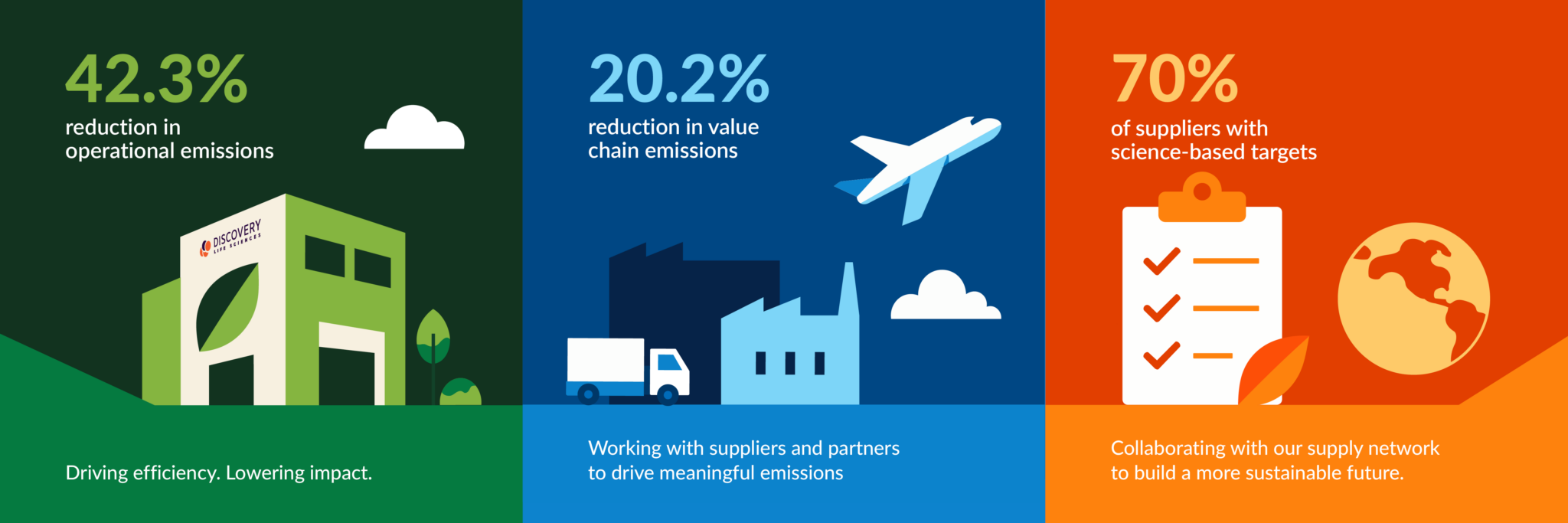
By 2031, we are targeting a 42.3% absolute reduction in Scope 1 and Scope 2 emissions and a 20.2% absolute reduction in Scope 3 emissions. Additionally, because much of our footprint sits with our partners, we have a science-based target (SBTi) engagement target for our suppliers covering more than 70% of our Scope 3 emissions.
Sustainability and scientific rigor are not competing priorities. Both come down to the same discipline: doing the work carefully, measuring it honestly, and improving it over time. We will report on our progress as we go.