The Reality of Clinical Trial Samples
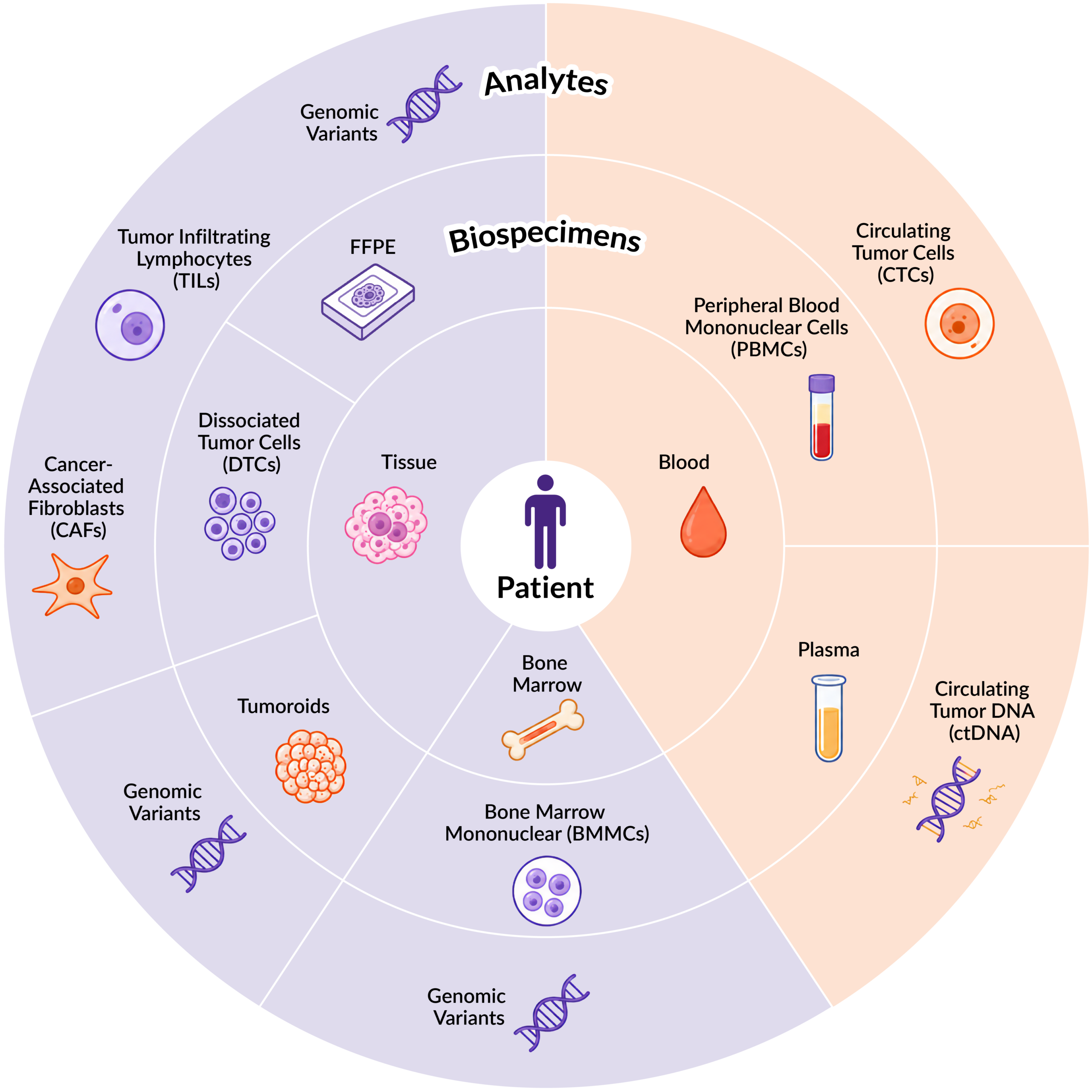
Biospecimens are an integral part of clinical research. Collected throughout clinical trials at different time points, these samples provide a wealth of information that can help researchers identify actionable biomarkers, understand therapeutic efficacy, and monitor disease progression.
But clinical trial samples are not always in optimal condition. Collected from patients, often with advanced-stage disease, samples may be limited in quantity or affected by biological and pre-analytical factors that cannot always be prevented, even with careful collection and handling. Factors such as low cell count, poor cell viability, and protein degradation can impact downstream analytical workflows and the quality of the data generated.
Yet these samples are precious, limited, and often irreplaceable. Understandably, the collection of biospecimens (such as blood, tissue, or saliva samples) is strictly regulated during clinical trials by the informed consent process to ensure patient safety, data integrity, and ethical compliance1,2. Every sample taken must be justified, carefully timed, and explicitly agreed to by the participant before any procedure begins. That means for many clinical studies, researchers may have only one opportunity to collect a sample from a particular patient at a particular time point, making it critical to extract as much information as possible from every biospecimen that is collected.
So, how can researchers prepare their analytical workflows before a trial begins to ensure they can work with samples that may not meet ideal quality specifications?
Stress-Test Your Analytical Workflow Before the Trial
Pre-analytical factors can arise at multiple points, from collection and processing through storage and transport, making it important to understand which variables can be controlled and which must be accommodated by the analytical workflow. Rather than evaluating an assay only with ideal or healthy donor samples, researchers can use disease-state biospecimens with characteristics that represent the real-world clinical trial samples they may encounter in a clinical study to stress-test their analytical workflows and understand how sample variability may affect performance.
Is a pre-processing step needed? What are the relevant acceptance criteria or detection limits? And at what point does a sample no longer generate reliable, usable data?
Additionally, there is no universal definition of a “bad” sample. A biospecimen that is unsuitable for one analytical workflow may be perfectly usable for another. Sample suitability is context-dependent and depends on the analyte or cell population of interest, the analytical method, and the performance requirements of the assay.
Disease-state biospecimens with associated clinical and molecular data can be used to build cohorts that are representative of the intended clinical trial population. Information such as disease stage, prior treatment exposure, and molecular characterization (e.g., next-generation sequencing) may help researchers evaluate assay performance across relevant biological variability, establish application-specific acceptance criteria, and make informed decisions about how to manage the variability of clinical biospecimens before a trial begins. This is the approach Discovery Life Sciences (Discovery) takes when helping researchers assess analytical workflows using samples that more closely reflect the characteristics of real-world clinical trial populations.
Build a Workflow Ready for Real-World Samples
In addition to disease-state biospecimens, healthy donor biospecimens can provide a controlled and accessible starting material for method development. Researchers can use these samples to evaluate specific sample-preparation strategies, introduce defined variables, and optimize workflow conditions before moving to precious clinical biospecimens.
For example, Discovery collaborated with a customer planning to use 10x Genomics single-cell RNA sequencing (scRNA-Seq) as their analytical readout for a Sickle Cell Anemia trial, where elevated levels of RBC carryover in patient-derived blood samples were an anticipated challenge for downstream analysis. Excess RBCs can create several technical hurdles, including reducing the concentration of target cells, complicating accurate cell counting, and contributing to ambient RNA that absorbs sequencing capacity3. Collectively, these factors can reduce the efficiency of single-cell workflows and increase technical variability between experiments.
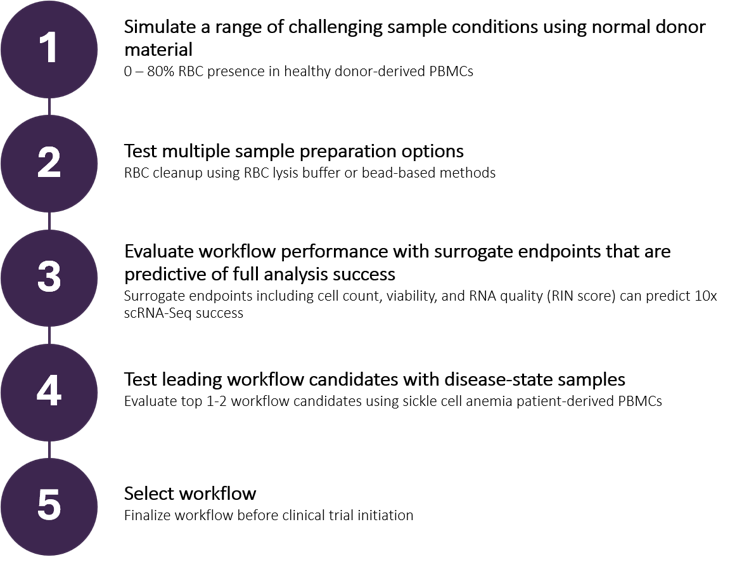
To stress test the workflow, Discovery used blood samples from multiple healthy donors and established a range of RBC levels, from no RBCs to 80% RBC presence (Figure 1). The samples were then processed using different RBC removal techniques, including RBC lysis and bead-based removal, to evaluate their impact on recovery and viability of the cells of interest.
Surrogate endpoints were used to evaluate the effectiveness of RBC clean up strategies without the time and cost of unnecessary single-cell sequencing. In this case, cell counts, cell viability, and RNA quality (RNA integrity scores) were selected because they are predictive of 10x scRNA-Seq success. These metrics were evaluated across the different conditions to assess the impact of each preprocessing approach for downstream sequencing.
Following this initial evaluation, the leading workflow candidates were tested using sickle cell disease patient samples to confirm that the selected approaches could perform effectively with disease-state material. This approach enabled the customer to make informed decisions about sample preparation, allowing them to enter the clinical trial with a workflow that had already been evaluated and optimized.